English
  Deutsch
  Español
  Türkçe
  Italiano
  Русский
  Français
  Português
  العربية
  Українська
  Nederlands
 An aluminum wheelchair ramp provides a practical way to create access across steps, thresholds and other changes in level. Portable and folding designs can also be transported or stored when permanent access is not required.
But choosing the right ramp involves more than comparing length, price or maximum load.
A ramp suitable for one entrance or mobility device may not work equally well in another application. The required rise affects ramp length and incline; usable width determines equipment compatibility; structural design influences rigidity and load performance; and the surface, side edges and folding system all affect practical use.
A useful selection sequence is:
Application → Rise Height → Ramp Length → Usable Width → Required Load → Surface & Edge Design → Portability
The following seven factors explain how these requirements affect the final ramp design.

Quick Overview: 7 Factors That Define the Right Ramp
| Key Factor | What Matters | Why It Matters |
| 1. Ramp Length & Incline | Rise height, available length and application | Determines the resulting approach angle |
| 2. Usable Width | Clear travel width, not only overall width | Determines compatibility with mobility equipment |
| 3. Rated Load | Required working capacity | Defines the structural requirement |
| 4. Aluminum Structure | Profiles, deck, supports and joints | Influences rigidity, strength and product weight |
| 5. Anti-Slip Surface | Surface texture and traction | Affects grip during use |
| 6. Side Edges & Transitions | Edge protection and entry/exit geometry | Influences wheel guidance and smooth access |
| 7. Portability & Storage | Folding system, handles and stored dimensions | Determines transport and storage convenience |
The goal is not to maximize every specification. A good ramp combines these factors according to the intended application.
1. Start with Ramp Length and Incline
Ramp length should be selected only after the required vertical rise is known.
For the same rise, increasing ramp length creates a gentler incline, while reducing the length produces a steeper approach.
The basic relationship is:
Rise ÷ Ramp Length = Slope
However, there is no single ramp length that is appropriate for every application.
The final configuration depends on:
- vertical rise;
- available installation space;
- intended mobility equipment;
- temporary or regular use;
- user requirements;
- applicable local accessibility requirements.
This distinction is particularly important for portable ramps.
A ramp may physically bridge a particular height, but that does not automatically mean the resulting installation is appropriate for every user or satisfies accessibility requirements in every market.
For this reason, accurate product dimensions should be considered together with the actual installation environment.
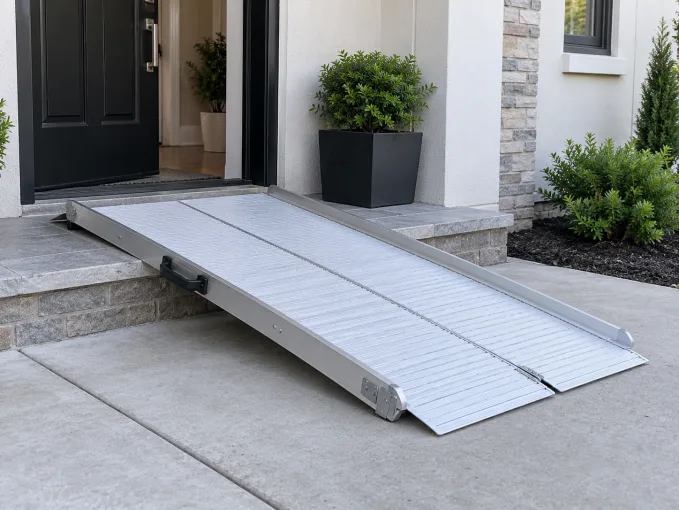
2. Check Usable Width, Not Just Overall Width
Ramp width is often presented as a single specification, but overall width and usable width are not necessarily the same.
Side profiles and raised edges occupy part of the external width. The clear space available for wheelchair wheels can therefore be narrower than the overall dimension.
The important dimensions are:
- overall external width;
- clear usable width;
- side-profile width;
- clearance between raised edges.
This becomes more important when a ramp is intended for different mobility devices. Manual wheelchairs, powered wheelchairs and other mobility equipment can differ in overall width and wheel position.
Side Profiles Affect More Than Width
Depending on the ramp design, the side profile can perform two functions at the same time.
It can contribute to the structural rigidity of the ramp while also forming the raised edge that defines the usable travel area.
Reducing the side profile simply to gain more usable width can therefore influence structural performance.
For a well-balanced design:
Usable Width + Side-Profile Geometry + Structural Rigidity
need to be considered together.
3. Evaluate Rated Load as a Complete Structure
Rated load describes the performance of the complete ramp, not a single aluminum component.
During use, the load is transferred through:
User & Mobility Equipment → Ramp Deck → Structural Profiles / Supports → End Contact Areas → Supporting Surfaces
On a folding ramp, hinges and connecting structures also become part of this load path.
Important structural areas therefore include:
- ramp deck;
- side profiles;
- cross-supports where applicable;
- welded or mechanical joints;
- folding hinges;
- upper and lower support areas.
Ramp length also matters. As the working span changes, so do the structural demands placed on the deck and supporting profiles.
This is why load capacity needs to be considered together with ramp length and structural geometry rather than as an isolated specification.
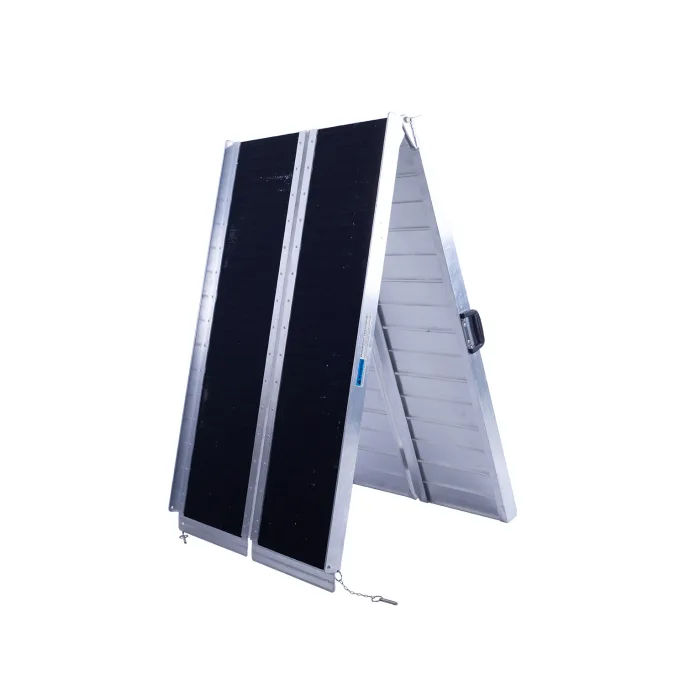
4. Look Beyond “Aluminum”—Structure Matters
Aluminum is widely used for portable wheelchair ramps because it provides a useful balance of structural performance, corrosion resistance and relatively low product weight.
However, the material itself tells only part of the story.
Two ramps using similar aluminum thickness can perform differently because of differences in:
- side-profile geometry;
- deck construction;
- cross-support arrangement;
- reinforcement locations;
- joint design;
- hinge structure;
- overall span.
This becomes increasingly important as ramp length increases.
Structural rigidity depends on the geometry of the complete assembly rather than simply the thickness of an individual component.
For a portable ramp, the design therefore needs to balance:
Structural Rigidity + Required Load + Ramp Length + Product Weight + Portability
Adding material everywhere can create unnecessary weight. Reducing material purely to achieve a lighter product can compromise rigidity.
An efficient structure places material and reinforcement where they contribute most to the performance of the complete ramp.
5. Examine the Anti-Slip Surface
The ramp deck is the primary contact area for wheelchair tires, making surface traction an important part of the design.
Depending on the product, grip may be provided by:
- textured aluminum;
- punched or formed traction patterns;
- applied anti-slip materials;
- other purpose-designed surface treatments.
The appropriate solution depends on the intended environment and ramp construction.
For outdoor applications, the surface may be exposed to moisture, dirt and repeated use. Its performance therefore needs to be considered beyond how it feels when new and dry.
More aggressive texture is not automatically better.
The surface needs to provide useful traction while still allowing smooth wheelchair movement and practical cleaning.
For this reason, the anti-slip surface should be treated as a functional part of the ramp rather than simply a visual finish.
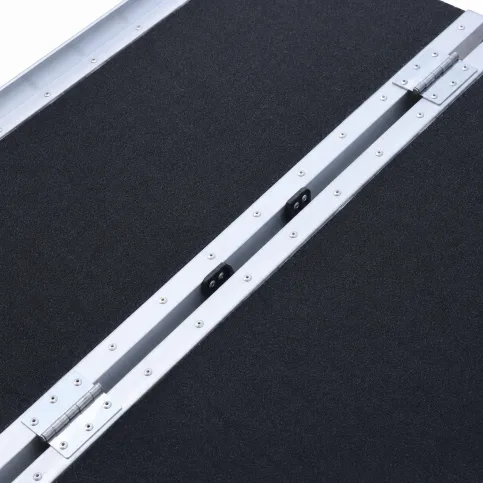
6. Side Edges and Transition Points Matter
The usable travel path extends beyond the center section of the ramp.
Raised side edges define the travel area and help prevent wheels from moving beyond the edge of the deck.
Effective side-edge design depends on:
- edge height;
- continuity along the usable area;
- connection with the ramp deck;
- exposed edge finishing;
- available wheel clearance.
The upper and lower transitions are equally important.
At the upper end, the ramp needs to make stable contact with the supporting surface. At the lower end, the transition between the ground and ramp should avoid an unnecessarily abrupt change in level.
The complete travel path can therefore be considered as:
Approach Surface → Lower Transition → Ramp Deck → Upper Transition → Destination Surface
A well-designed deck can still be inconvenient to use if either transition is poorly resolved.
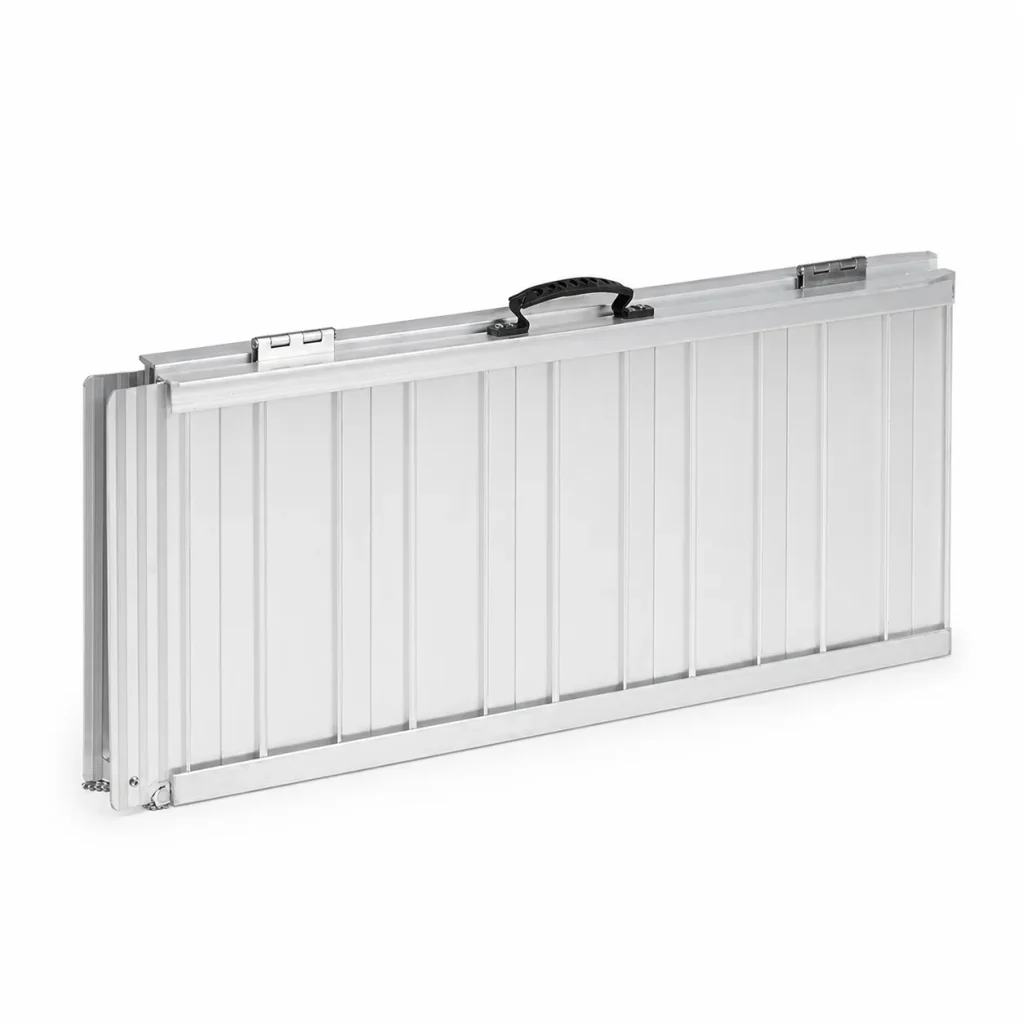
7. Consider Folding, Portability and Storage
For a portable aluminum wheelchair ramp, working dimensions are only part of the product requirement.
The ramp may also need to be carried, loaded into a vehicle or stored when not in use.
Different structures provide different compromises between working length and stored size.
| Ramp Type | Main Characteristic | Key Design Consideration |
| Single-Piece | Continuous structure | Simple construction but requires more storage length |
| Bi-Fold | Folds into a more compact form | Hinge alignment and folded dimensions |
| Multi-Fold | Further reduces stored dimensions | Additional joints and locking points |
| Telescopic | Adjustable working length | Extension and locking structure |
| Threshold Ramp | Designed for smaller level changes | Different application from longer access ramps |
Folding introduces additional structural components.
Hinges and locking points need to maintain alignment in the working position while still allowing the ramp to fold reliably for transport.
Carrying handles also need to be positioned appropriately. Their location influences how balanced the folded ramp feels when carried and whether the handle interferes with the ramp during use.
The final design therefore needs to balance:
Working Length + Structural Performance + Folded Size + Product Weight + Carrying Convenience
Key Specifications to Confirm Before Production
Once the intended application and ramp type are defined, the main product specification can be established.
| Specification | Information to Confirm |
| Ramp Type | Single-piece, folding, multi-fold, telescopic or threshold |
| Application / Vertical Rise | Intended installation condition |
| Ramp Length | Required working length |
| Overall Width | Complete external width |
| Usable Width | Clear travel width |
| Rated Load | Required working capacity |
| Aluminum Structure | Profile and structural configuration |
| Anti-Slip Surface | Required traction solution |
| Side Edges | Edge protection requirements |
| Folding System | Hinge and locking requirements, if applicable |
| Product Weight | Target weight for portable applications |
| Finish | Required surface treatment |
| Branding | Logo, labels and product identification |
| Packaging | Retail, B2B or private-label requirements |
Defining these specifications before sampling also makes different products easier to compare.
Two aluminum wheelchair ramps may appear almost identical in a catalogue while using different profiles, usable widths, load ratings or folding structures.
Manufacturing Details That Affect Ramp Consistency
For an aluminum wheelchair ramp, manufacturing quality is not simply about producing a clean-looking sample.
Several dimensional and structural details directly affect how the finished ramp performs.
Long-Profile Straightness
Long aluminum side profiles need to remain straight and dimensionally consistent.
Variation can affect the overall ramp geometry and how the product sits between its upper and lower contact surfaces.
Left and Right Profile Consistency
The two sides of the ramp need to maintain consistent dimensions and positioning.
Differences between the left and right structures can affect deck alignment, hinge positioning and final assembly.
Deck-to-Profile Connection
The connection between the ramp deck and supporting side structure is part of the load path.
Its position and assembly therefore need to remain consistent throughout production.
Hinge Alignment on Folding Ramps
For folding designs, hinge positioning is particularly important.
Misalignment can affect:
- opening and closing;
- alignment in the working position;
- folded dimensions;
- how the two sections sit together.
Anti-Slip Surface Consistency
The traction surface should remain consistent across the usable area and between production units.
Variation in applied materials, formed patterns or other surface treatments can affect both appearance and function.
Final Open and Folded Dimensions
For portable products, inspection should cover both configurations.
The finished ramp should match the confirmed working dimensions when opened and the required storage dimensions when folded.
These product-specific control points are what turn an approved ramp design into a repeatable production product.

Developing an Aluminum Wheelchair Ramp with EZLEE
For an aluminum wheelchair ramp project, EZLEE can work from an existing product, technical drawing or target specification to review key requirements such as ramp length, usable width, aluminum profile structure, required working load, anti-slip surface, side-edge design and folding configuration.
Once the main structure is confirmed, surface finish, product labeling, private-label branding and packaging can be developed according to the project requirements.
EZLEE supports OEM and ODM projects from sample development through repeat batch production.
Looking for an aluminum wheelchair ramp for your product range? Contact EZLEE with your target specifications, reference product or drawing to discuss your project.