English
 Deutsch
 Español
 Türkçe
 Italiano
 Русский
 Français
 Português
 العربية
 Українська
 Nederlands
“Heavy duty” is one of the most common descriptions used for motorcycle workshop equipment. But adding thicker steel or increasing the product weight does not automatically create a better repair stand.
A true heavy duty motorcycle repair stand needs to remain stable while supporting the motorcycle, transfer the load through the correct structural points, operate smoothly under repeated use, and maintain its geometry over time.
For workshops, motocross riders and motorcycle accessory buyers, the difference is usually found in the details: the base, support platform, lifting mechanism, pivot points, welds and the way these parts work together as one structure.
Heavy Duty Starts with the Load Path
When a motorcycle is supported on a repair stand, the load does not act on one component alone.
The motorcycle weight first reaches the upper support platform. From there, the force is transferred through the central support structure and lifting linkage before reaching the base and finally the workshop floor.
A well-designed stand therefore needs a clear and stable load path:
Motorcycle → Support Platform → Main Structure → Pivot / Linkage → Base → Floor
If one part of this path is significantly weaker or poorly positioned, simply increasing the thickness of another component may not solve the problem.
For example, a strong upper platform provides little benefit if the base is too narrow. Likewise, a wide base cannot compensate for poorly aligned pivot points.
This is why structural balance matters more than adding unnecessary weight.

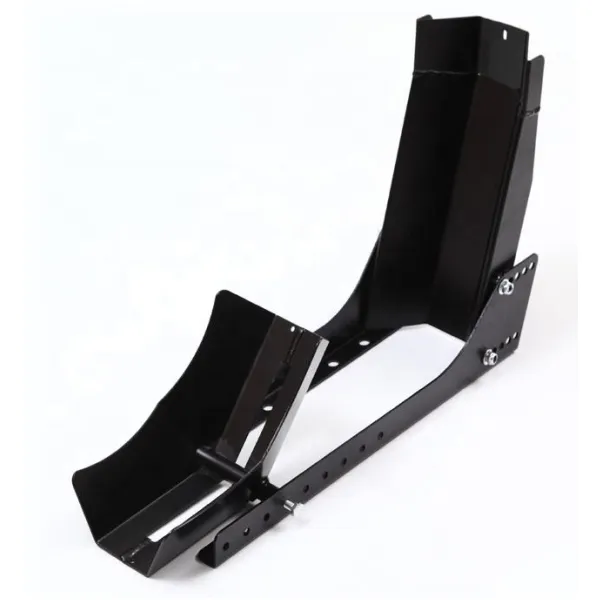
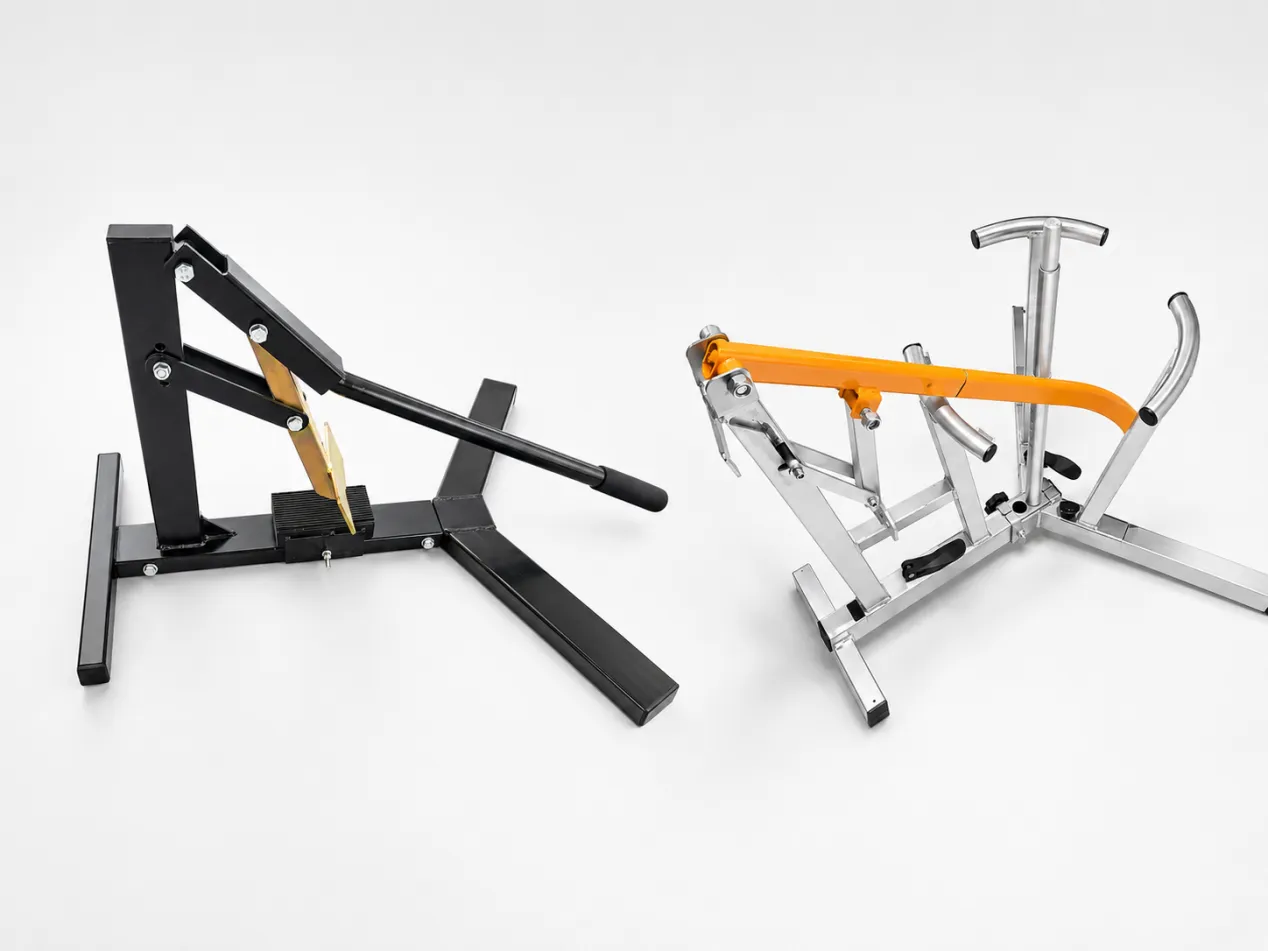
Heavy Duty Motorcycle Repair Stand
The Base Defines Stability
The base is one of the most important parts of a heavy duty motorcycle repair stand.
Its job is not only to carry vertical weight. It also needs to resist the forces created when:
- The motorcycle is positioned on the stand
- The lifting lever is operated
- A technician works on one side of the motorcycle
- Components such as wheels are removed
- The motorcycle weight shifts during maintenance
A wider footprint generally provides better stability, but base dimensions must also remain practical for workshop use and storage.
Important details include:
- Front-to-rear footprint
- Side-to-side width
- Position of the central support
- Direction of lever force
- Contact between the base and floor
- Alignment between the base and upper platform
A heavy duty stand should feel planted rather than unstable or excessively flexible when the motorcycle is raised.
The Support Platform Needs More Than Strength
The upper platform is the direct contact point between the repair stand and motorcycle.
For the EZLEE heavy duty motorcycle stand, two parallel support sections provide the contact area beneath the motorcycle. The stand is designed for motorcycle lifting and maintenance, with an adjustable working height from approximately 30 to 43 cm and a rated capacity of 200 kg.
The platform design needs to consider three things at the same time:
Contact Area
The motorcycle should rest on an appropriate structural area beneath the bike.
A platform that is too small may concentrate the load. A platform that is unnecessarily large may interfere with other motorcycle components.
Surface Grip
Anti-slip or rubber contact surfaces help improve grip and reduce direct metal-to-metal contact with the motorcycle.
These surfaces should remain securely attached during repeated workshop use.
Platform Alignment
The two support sections should remain parallel and correctly positioned.
Poor alignment can create uneven loading, which may affect both motorcycle stability and the stand structure itself.
Why Lever Geometry Matters
A lever-operated repair stand depends heavily on mechanical geometry.
The operator applies force at the handle. The linkage then converts this movement into vertical lifting.
The important question is not simply whether the stand can lift the motorcycle.
It is whether the lifting movement feels controlled and practical.
Key design factors include:
- Lever length
- Pivot location
- Linkage angle
- Travel distance
- Working height
- Return movement
- Clearance between moving components
A poorly positioned pivot may require excessive operating force. A lever that is too short may make lifting difficult, while an unnecessarily long lever can increase storage space and create interference around the motorcycle.
The mechanism should provide enough leverage to operate the stand without making the complete structure oversized.

Pivot Points Are Small Parts with a Large Job
The pivot points experience repeated movement every time the motorcycle is raised or lowered.
They must transfer load while allowing the lifting mechanism to move freely.
Important areas include:
- Pivot bolts
- Connecting plates
- Bushings or contact surfaces
- Hole alignment
- Fastener retention
- Clearance between moving parts
Excessive clearance may create unwanted movement. Insufficient clearance can cause binding and make operation difficult.
For a heavy duty stand, these areas need to remain consistent after repeated operating cycles.
This is one reason why accurate hole positioning and assembly are just as important as the steel itself.
Welding Has to Maintain the Geometry
Welding provides the permanent connections between many of the stand’s main structural components.
A strong-looking weld alone does not guarantee a reliable product.
The welding process must also keep the structure correctly aligned.
Excessive heat or inconsistent fixture positioning can result in:
- Base distortion
- Platform misalignment
- Incorrect pivot positions
- Uneven support surfaces
- Poor appearance
- Variation between production units
For a product with a moving lifting mechanism, even small dimensional changes can influence operation.
A suitable welding fixture helps maintain the position of the base, upright structure and connecting points throughout production.
The goal is therefore not simply “more welding.” It is consistent welding in the correct position.

Heavy Duty Does Not Mean Unnecessarily Heavy
There is a common assumption that a heavier repair stand must be stronger.
In reality, weight and strength are not the same thing.
A better structure uses material where it contributes to performance.
This may include:
- Appropriate steel tube dimensions
- Reinforcement around high-stress areas
- Correct joint design
- Controlled wall thickness
- Suitable support geometry
Adding material everywhere can increase:
- Product weight
- Material cost
- Packaging requirements
- Freight cost
- Difficulty of carrying the stand
For a portable motorcycle repair stand, unnecessary weight can actually reduce usability.
The objective is a structure that feels solid under load while remaining practical to move around a garage, workshop or paddock.

Working Height Changes the Maintenance Experience
A repair stand is not only used to hold the motorcycle.
Its working height determines how easily the user can reach different parts of the bike.
An adjustable stand can provide better access for tasks such as:
- Chain cleaning and lubrication
- Rear-wheel maintenance
- Brake inspection
- Bottom-frame inspection
- Cleaning after off-road riding
- General repair work
The EZLEE heavy duty motorcycle stand provides a working-height range of approximately 30–43 cm, allowing the motorcycle position to be adjusted according to the maintenance task.
However, increasing height also changes the centre of gravity of the complete motorcycle-and-stand system.
This is why working height cannot be evaluated independently from base geometry and platform position.
A heavy duty design must remain stable at its highest intended working position.
Real Workshop Use Is Repetitive
One successful lift does not tell the complete story.
In a workshop, the same stand may be raised and lowered repeatedly. Over time, repeated operation places wear on:
- Pivot holes
- Bolts
- Connecting plates
- Moving joints
- Springs
- Contact surfaces
- Rubber pads
- Painted surfaces
A product intended for repeated maintenance therefore needs to be evaluated not only for static load but also for how its moving structure behaves over time.
The mechanism should continue to operate smoothly without excessive looseness, visible distortion or misalignment.
This is where manufacturing consistency becomes particularly important.
Surface Treatment Is Part of Workshop Durability
Motorcycle repair equipment regularly comes into contact with dirt, oil, tools and workshop floors.
For steel stands, surface treatment protects the material while also determining how the product looks after repeated handling.
The EZLEE stand uses a powder-coated steel construction.
A consistent powder-coated finish should provide:
- Uniform surface appearance
- Coverage around welded areas
- Protection around edges and corners
- Consistent colour across production batches
- A surface suitable for normal workshop handling
Coating quality is especially visible around welds, holes, tube ends and moving areas.
These details influence the overall perception of product quality even though they do not change the basic lifting function.

A Heavy Duty Stand Is a Combination of Details
The performance of a motorcycle repair stand cannot be reduced to one specification.
| Product Area | What It Influences |
| Base geometry | Overall stability |
| Support platform | Motorcycle contact and load distribution |
| Steel structure | Strength and rigidity |
| Lever geometry | Operating effort |
| Pivot points | Smooth movement and long-term wear |
| Welding | Structural integrity and dimensional accuracy |
| Working height | Maintenance accessibility and centre of gravity |
| Anti-slip contact surface | Grip and motorcycle protection |
| Powder coating | Surface durability and appearance |
| Assembly accuracy | Consistent operation |
The strongest product is not necessarily the one with the thickest steel or the highest advertised capacity.
A truly heavy duty stand is one in which every structural part supports the same objective: stable, predictable and repeatable motorcycle maintenance.
Where a Heavy Duty Motorcycle Repair Stand Is Used
The same core product can be useful in several real maintenance environments.
Home Garage
Enthusiasts need a compact stand that can be stored easily while providing better access for regular maintenance.
Professional Motorcycle Workshop
Frequent operation makes structural consistency, stability and moving-component durability more important.
Motocross and Off-Road Paddock
A repair stand can provide a practical working position for cleaning, chain maintenance and basic servicing between riding sessions.
Motorcycle Dealer Service Area
The stand can support preparation, inspection and routine workshop operations without requiring a large permanent motorcycle lift.
The structure remains the same, but the intensity and frequency of use differ significantly between these environments.
Manufacturing Consistency Is What Makes “Heavy Duty” Repeatable
For a manufacturer, producing one strong prototype is not enough.
The challenge is maintaining the same geometry and operation across mass production.
For a heavy duty motorcycle repair stand, production control may include:
- Steel material verification
- Tube cutting accuracy
- Hole positioning
- Welding fixture control
- Base alignment
- Platform alignment
- Pivot installation
- Lever and linkage assembly
- Functional lifting checks
- Surface inspection
- Final packaging inspection
When these steps remain controlled, the stand received in a repeat order should behave like the approved sample.
That consistency matters just as much as the original product design.
Heavy Duty Motorcycle Repair Stand Manufacturing with EZLEE
At EZLEE, we manufacture motorcycle maintenance and workshop equipment for B2B customers.
Our heavy duty motorcycle repair stand is manufactured from steel with a powder-coated surface, a rated capacity of 200 kg, and an adjustable working height of approximately 30–43 cm.
For different projects, we can also evaluate requirements involving:
- Product dimensions
- Steel specifications
- Working height
- Support-platform design
- Colour
- Surface finish
- Branding
- Labels
- Instruction manuals
- Packaging
Projects can begin from an existing product, technical drawing, physical sample or defined product requirements.
If you are looking for a heavy duty motorcycle repair stand for your motorcycle accessory or workshop-equipment range, contact EZLEE with your required specifications, reference product or target application. Our team can review the project and discuss a practical manufacturing solution.