English
 Deutsch
 Español
 Türkçe
 Italiano
 Русский
 Français
 Português
 العربية
 Українська
 Nederlands
A motorcycle workshop does not lose efficiency only when a mechanic works slowly. Time is also lost when a bike has to be repositioned repeatedly, when access to the underside is limited, or when a technician spends part of the job working in an uncomfortable position.
For off-road motorcycle service, these issues are especially common. Dirt bikes frequently require wheel removal, chain adjustment, suspension inspection, cleaning and underbody access. A dirt bike hydraulic jack can turn these tasks into a more controlled workshop process by raising the motorcycle to a practical working height and keeping the service area accessible.
For workshop equipment distributors, powersports dealers and private-label brands, the commercial value of this product is therefore not limited to lifting capacity. Its real value lies in how it fits into the daily workflow of a professional service business.

Start with the Workshop, Not the Product
A dirt bike hydraulic jack should not be viewed as a larger version of a basic motorcycle stand.
The typical design combines:
- A hydraulic lifting system
- A scissor-style lifting mechanism
- A wide top platform
- A stable lower frame
- Lockable or controllable lifting positions
- Castors or workshop wheels on some models
This structure allows the motorcycle to be raised gradually rather than lifted in one fixed movement. The technician can select a working height, move around the motorcycle and access areas that are difficult to reach when the bike remains close to the floor.
That makes the product particularly relevant to workshops handling regular maintenance rather than occasional home-garage repairs.
Where Workshop Time Is Commonly Lost

Before discussing specifications, it is more useful to understand the service problems the equipment is intended to solve.
Repeated repositioning
When a dirt bike is supported by a basic stand, the mechanic may still need to change the bike’s position to access the wheels, chain, suspension or underside.
A hydraulic scissor jack can provide a more central working position, reducing unnecessary movement during the job.
Limited access underneath the bike
Mud, impact and off-road riding place additional demands on skid plates, lower-frame areas, exhaust components and suspension systems.
Raising the motorcycle gives technicians more space to inspect and clean these areas without constantly bending or working from the floor.
Inconsistent working height
Not every technician works comfortably at the same height, and not every service task requires the motorcycle to be positioned in the same way.
A hydraulic lifting mechanism allows the platform height to be adjusted according to the job rather than forcing every task into one fixed position.
Moving a partially serviced motorcycle
A model fitted with suitable castors can allow the workshop to reposition the motorcycle within the service area when necessary.
This can be useful in workshops with several workstations, shared tools or limited floor space. The equipment must still be used with appropriate wheel locks, safety controls and motorcycle securing methods.
Four Jobs That Show the Real Value of the Equipment
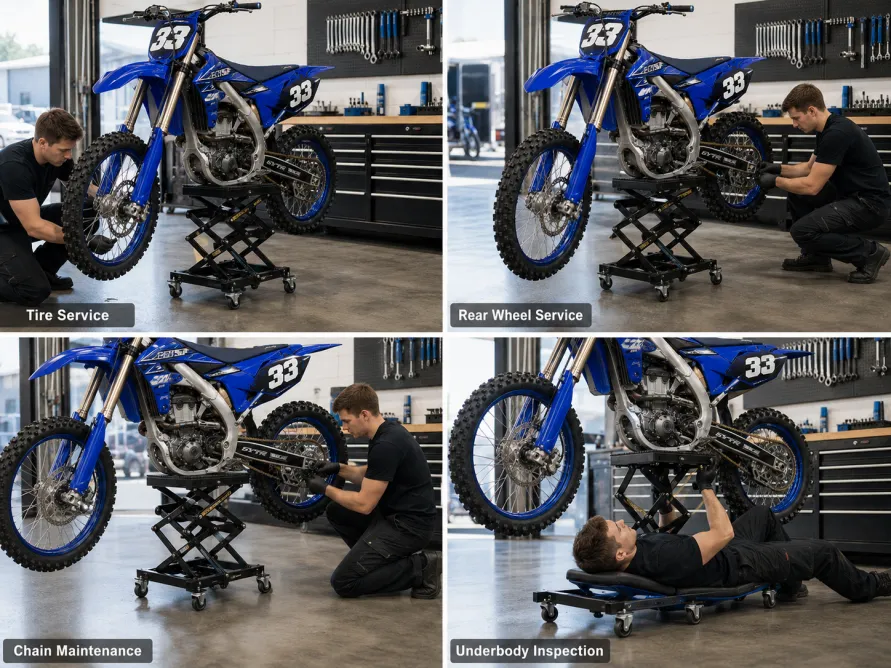
Hydraulic Motorcycle Jack 1500 lbs
A professional article about a dirt bike hydraulic jack should not stop at “easy maintenance.” The product becomes more commercially convincing when buyers can see which workshop operations it supports.
1. Wheel and Tyre Service
Removing a front or rear wheel requires the motorcycle to remain stable while one end is unsupported.
A hydraulic jack can lift the motorcycle to a suitable position for:
- Tyre replacement
- Tube repair
- Wheel inspection
- Brake service
- Sprocket work
- Bearing inspection
For workshops serving motocross and enduro customers, these are routine jobs rather than occasional repairs.
2. Suspension Inspection and Replacement
Off-road motorcycles place significant loads on forks, rear shocks, linkages and swingarms.
When the motorcycle is properly secured and supported, a hydraulic lifting platform can make it easier to inspect suspension movement, remove components and maintain a stable working position throughout the job.
The lifting platform must contact an appropriate structural area beneath the motorcycle. It should never rely on a plastic panel, exhaust system or other unsuitable component as the primary support point.
3. Chain, Sprocket and Drivetrain Maintenance
Chain cleaning, lubrication, adjustment and sprocket replacement all benefit from easier access to the rear wheel and swingarm area.
A stable elevated position gives the mechanic a clearer view of:
- Chain alignment
- Chain tension
- Rear sprocket wear
- Swingarm condition
- Rear brake components
This is especially relevant for off-road bikes, where mud and abrasive dirt can accelerate wear.
4. Cleaning and Post-Ride Inspection
For motocross teams and off-road service businesses, cleaning is part of maintenance.
Lifting the motorcycle makes it easier to remove mud from the underside and inspect the bike for loose fasteners, damaged protection parts or fluid leaks after riding.
This helps position the hydraulic jack not only as repair equipment, but also as part of a regular workshop inspection process.
Turning Specifications into Business Value
Importers and distributors often compare workshop products through technical specifications. However, specifications become more useful when they are connected to their effect on the workshop and the end customer.
| Product element | Workshop impact | B2B purchasing relevance |
| Minimum platform height | Makes it easier to position the jack beneath suitable motorcycles | Affects model compatibility |
| Maximum lifting height | Determines the available working position | Influences workshop usability |
| Platform dimensions | Controls the contact area beneath the bike | Important for stability and fitment |
| Rated capacity | Defines the permitted motorcycle weight | Must match the intended product category |
| Hydraulic cylinder | Controls lifting action and load movement | Reliability affects warranty risk |
| Scissor mechanism | Provides vertical movement and structural support | Welding and alignment must be consistent |
| Safety lock or support device | Helps prevent uncontrolled lowering | Critical for professional use |
| Castors and brakes | Support workshop mobility and positioning | Quality affects stability and user confidence |
| Rubber platform surface | Improves grip and protects contact areas | Reduces slipping and surface damage |
| Tie-down points | Allow additional motorcycle securing | Useful for workshop safety and transport within the service area |
This is the level of information professional buyers need before deciding whether the product is suitable for their market.
Compatibility Requires More Than a Weight Rating
One of the most important points for distributors is that not every dirt bike has the same underside structure.
Some motorcycles have a relatively flat lower frame or skid plate area. Others have protruding exhaust components, uneven engine protection or limited safe contact space.
For this reason, product compatibility should be explained through more than a single load-capacity figure.
A professional product listing should clearly show:
- Top platform dimensions
- Minimum and maximum lifting height
- Recommended contact area
- Applicable motorcycle types
- Correct securing method
- Situations where an adapter may be required
- Warnings against supporting unsuitable components
Clear compatibility information helps reduce incorrect purchases, unsafe use and unnecessary after-sales claims.
The Safety Features Buyers Should Inspect in a Sample

A hydraulic jack may look impressive in photos, but several details should be inspected physically before a bulk order is approved.
Controlled lifting and lowering
The platform should rise smoothly and remain reasonably level throughout the lifting range.
Lowering should be controllable rather than sudden. Irregular movement may indicate hydraulic or linkage issues.
Mechanical safety support
The hydraulic cylinder should not be the only element relied on to hold the motorcycle at working height.
A suitable mechanical locking or support system adds an important layer of protection during service work.
Scissor alignment
The lifting arms, pivot points and platform should remain correctly aligned throughout the full movement.
Poor alignment can produce uneven loading and premature wear.
Base stability
The base should resist rocking or twisting under the rated load.
For models with castors, the wheel arrangement and braking system must provide a stable service position.
Platform grip
The top surface should provide sufficient friction and should not damage the motorcycle’s lower frame or protection plate.
Fasteners and pivot points
Bolts, pins, bushes and retaining parts should be secure, consistent and accessible for inspection or service.
For B2B buyers, these areas have a direct relationship with warranty exposure and brand reputation.
Why Serviceability Matters to Distributors
A hydraulic workshop product contains more service-sensitive parts than a fixed steel stand.
Over time, end users may need support relating to:
- Hydraulic seals
- Pump assemblies
- Release valves
- Castors
- Rubber pads
- Pins and retaining hardware
- Safety-lock components
A distributor should therefore evaluate whether spare parts can be supplied and whether the manufacturer can provide exploded diagrams, maintenance instructions or replacement guidance.
This is particularly important for private-label programmes. The brand shown on the product will usually receive the customer’s first complaint, even when the problem originates from a small replaceable component.
A product that can be serviced is easier to support than one that must be replaced entirely.
Procurement Questions Worth Asking Before a Bulk Order
Professional buyers should obtain clear answers to the following questions:
- What is the tested load capacity?
- What are the minimum and maximum platform heights?
- What are the platform dimensions?
- Is there a mechanical safety-lock system?
- Are the castors fitted with reliable brakes?
- Can replacement hydraulic and wear parts be supplied?
- What inspection is performed on the cylinder and lifting mechanism?
- Is each unit function-tested before packing?
- How is the product protected from scratches and impact during transport?
- Can manuals, labels and packaging be customized for the target market?
These questions are more useful than comparing the headline unit price alone.
The Commercial Case for Importers and Workshop Equipment Brands
The business case for a dirt bike hydraulic jack is based on three factors.
First, it supports recurring workshop tasks rather than one occasional use.
Second, it provides a higher-value equipment option within a motorcycle maintenance range.
Third, it creates opportunities for distributors to supply related products and replacement parts over time.
For an importer, this makes the product suitable for a more professional market position than an entry-level stand. For a private-label brand, it can strengthen the workshop equipment section of the catalog and provide a logical step between compact motorcycle stands and larger lift tables.
Discuss Hydraulic Motorcycle Lifting Solutions with EZLEE


A dirt bike hydraulic jack must combine lifting performance, structural stability, appropriate motorcycle contact and practical workshop operation. For B2B buyers, serviceability, packaging and repeat-order consistency are just as important as the initial specification.

EZLEE supports wholesale, OEM and private-label motorcycle equipment projects, including product configuration, metal fabrication, surface treatment, packaging development and bulk production.
To discuss a hydraulic motorcycle scissor jack for your workshop-equipment or powersports product range, please contact EZLEE with your required load capacity, lifting range, platform dimensions, packaging needs and target market.