English
  Deutsch
  Español
  Türkçe
  Italiano
  Русский
  Français
  Português
  العربية
  Українська
  Nederlands
 A motorcycle tire changer stand (manual motorcycle tire changer, motorcycle tire stripper, or motorcycle bead-breaking tool) may look mechanically simple, but manual tire service places considerable force on the equipment.
When the operator pushes the lever to separate a tire bead, the stand needs to remain stable while the working end transfers force into the tire sidewall. Excessive movement in the base, frame or lever wastes force and makes the operation harder to control. Its performance depends primarily on four areas: base stability, lever geometry, frame rigidity and controlled tire contact.
What Does a Motorcycle Tire Changer Stand Actually Do?
A manual motorcycle tire changer stand assists with tire-service operations without requiring a powered hydraulic or pneumatic machine.
One of its most important functions is helping the operator separate the tire bead from the rim. The operating force follows a simple mechanical path:
operator → lever → tire contact point → frame → base
The more effectively the structure transfers this force, the easier it is to control the operation.
When the operator presses the lever, the base should remain planted and the working end should move predictably into the tire sidewall. This is why the product should be evaluated as a complete mechanical system rather than simply by its weight or appearance.
A Stable Base Keeps the Tool in Position
Base geometry directly affects how the stand behaves under load.
Force applied through a long lever is not purely vertical. It can also introduce lateral and rotational loads into the frame. If the base moves as pressure is applied, part of the operator’s effort is lost.
The objective is therefore not simply to make the product heavier. A better design distributes the structure around the working area so that it remains supported while still keeping the footprint practical.
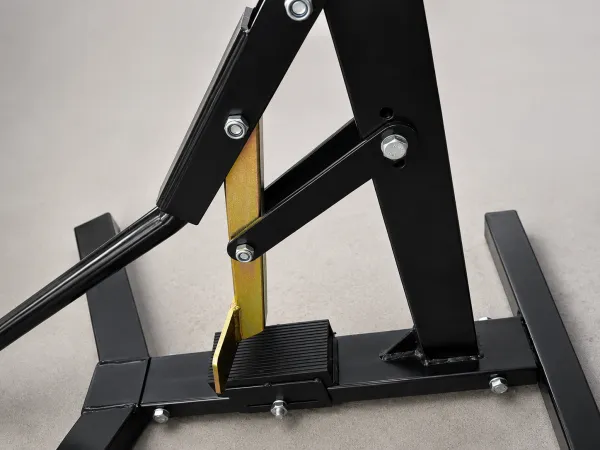
For motorcycle workshops, this balance matters. Tire-service tools often share space with repair stands, paddock stands, wheel chocks, jacks and other equipment.
A compact stand can be easier to store and reposition, but compact dimensions should not come at the expense of stability.
Lever Geometry Determines Mechanical Advantage
The lever is one of the defining components of a manual motorcycle tire changer.
Its purpose is to provide mechanical advantage so the operator can generate greater force at the tire contact point with less direct effort.
A longer effective lever arm generally reduces the force required from the operator, but lever length alone does not determine performance.
The lever also needs sufficient rigidity, a stable connection to the frame, an appropriate operating angle and enough clearance through its working range.
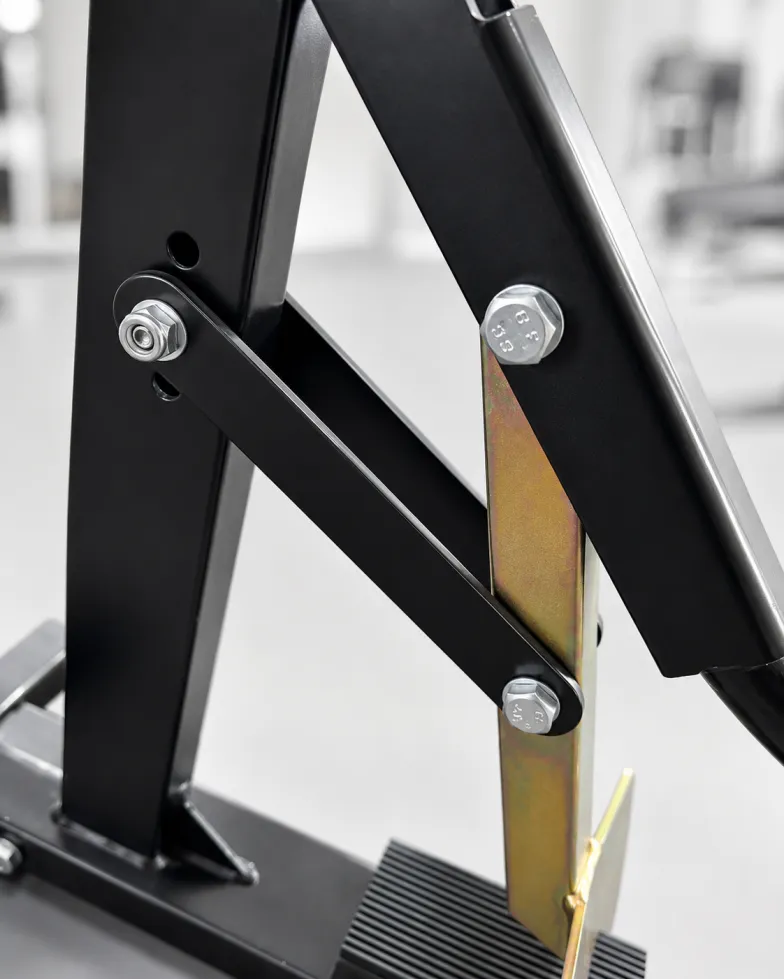
If the tube flexes significantly under load, part of the operator’s movement is absorbed by the lever itself rather than transferred into the tire. The lever and supporting structure therefore need to work as one system.
The Tire Contact Point Needs Controlled Positioning
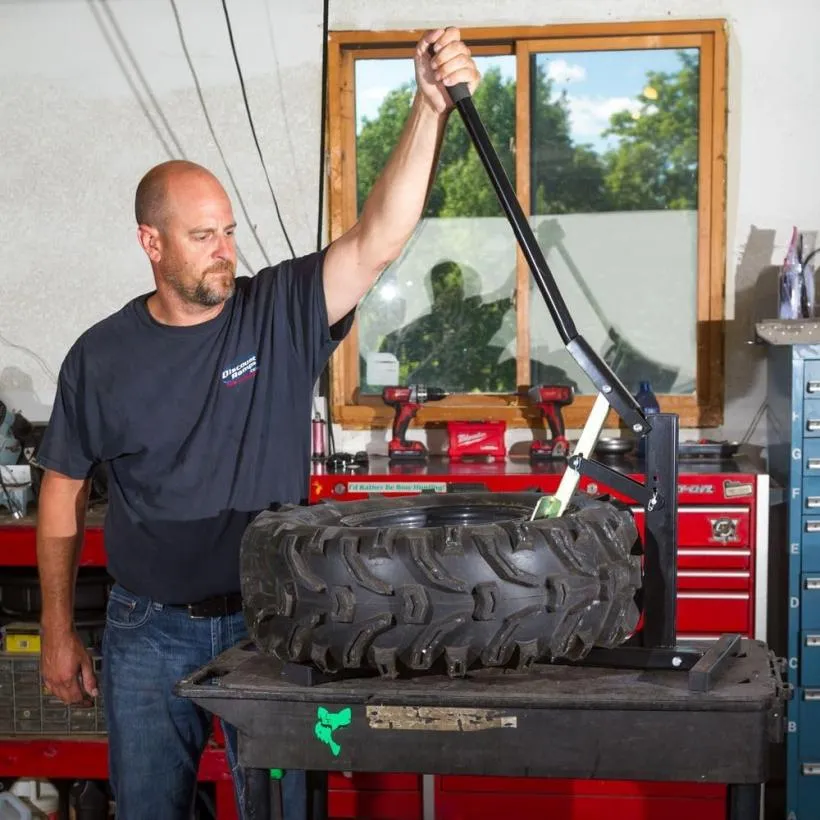
Generating force is useful only when that force reaches the correct area.
During bead breaking, the working component needs to press into the tire sidewall close enough to the bead to create movement without unnecessarily contacting the rim.
Poor positioning can lead to slipping, repeated repositioning or inefficient force transfer.
The contact geometry therefore needs to provide three things:
appropriate position, controlled movement and sufficient working clearance.
This is a small structural detail, but it can have a major effect on how practical the tool feels during actual use.
Frame Rigidity and Joint Accuracy Matter Together
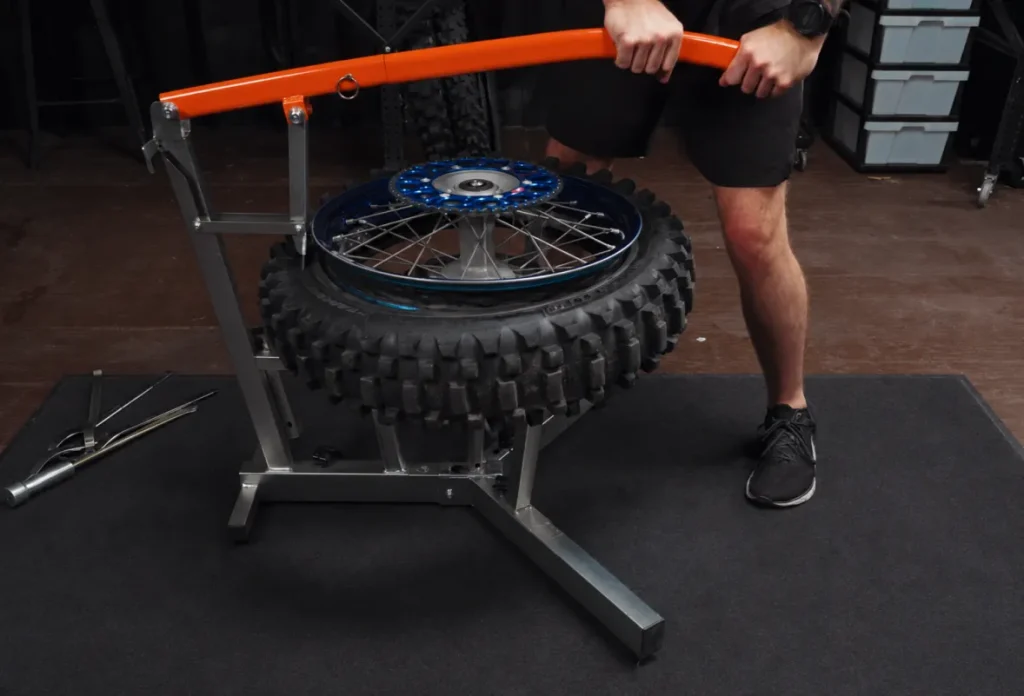
The frame connects the lever, working end and base into one load-bearing structure.
The most important areas are usually the points where force changes direction, including the base-to-frame connection, lever mounting area, working brackets and welded joints.
Simply increasing steel thickness everywhere is not necessarily the best solution. More important is placing sufficient material and reinforcement where the working load actually travels.
Manufacturing accuracy is equally important.
A bracket welded at the wrong angle can change the lever position or tire-contact geometry. A distorted base can prevent the tool from sitting evenly, while poor alignment can reduce working clearance.
For repeated production, welding fixtures and dimensional control therefore matter just as much as the nominal material specification.
Tire and Wheel Compatibility Should Be Clearly Defined
Motorcycle tires and wheels vary considerably in diameter, width and overall geometry.
The usable range of a motorcycle tire changer stand therefore depends on the physical clearance and working geometry of the actual structure.
Relevant factors may include tire diameter, tire width, wheel dimensions and the operating range of the contact mechanism.
This is why broad claims such as “universal” should be used carefully.
For professional and B2B applications, a clearly defined compatibility range is more useful than a general universal-fit statement. It also helps distributors describe the product more accurately to their own customers.
Two Manual Tire-Service Structures from EZLEE
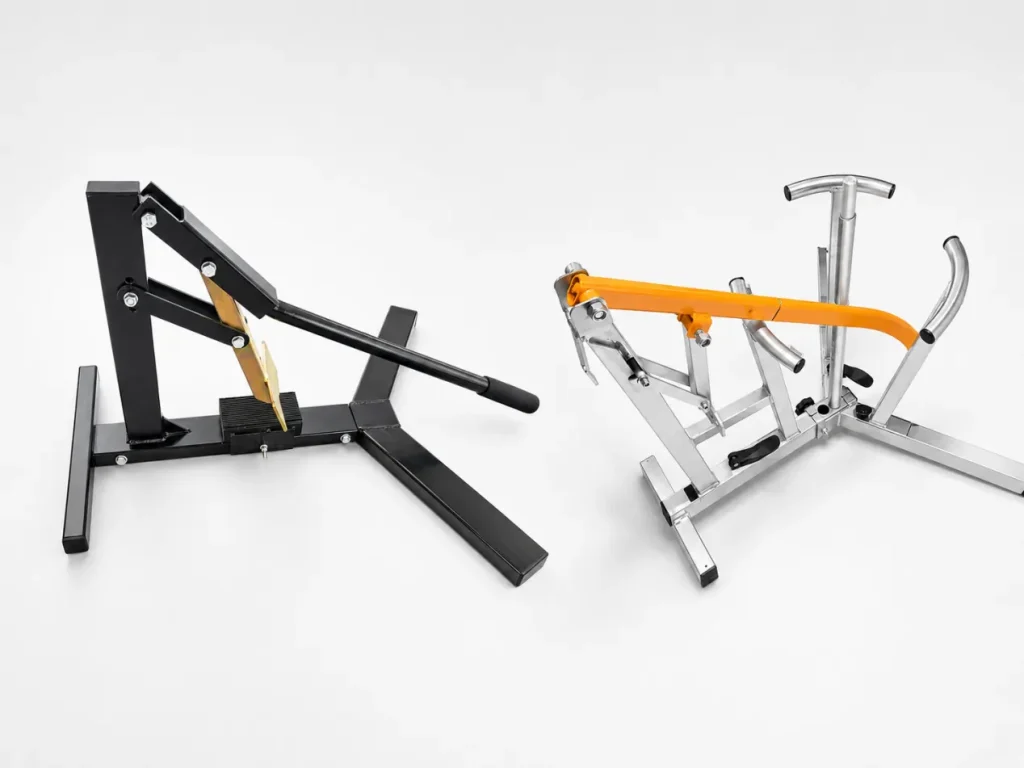
EZLEE‘s current motorcycle equipment catalog includes two manual tire-service products:
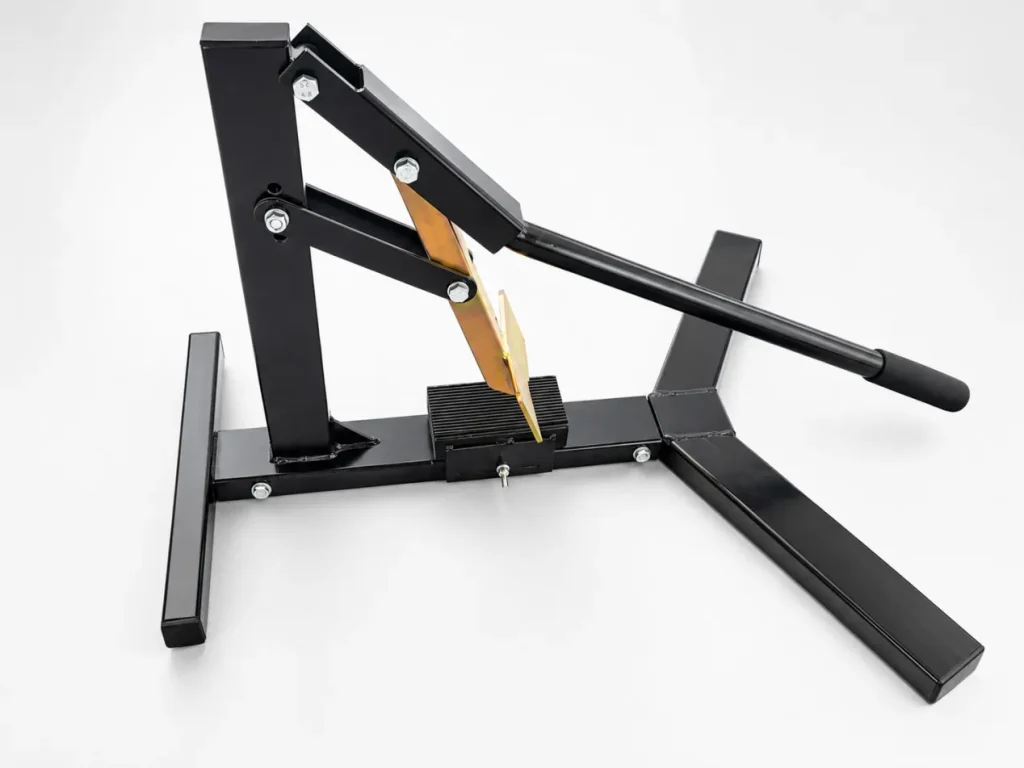
Y-type Motorcycle Tire Stripper and Motorcycle Tire Stripper.
The two models use visibly different structural layouts.
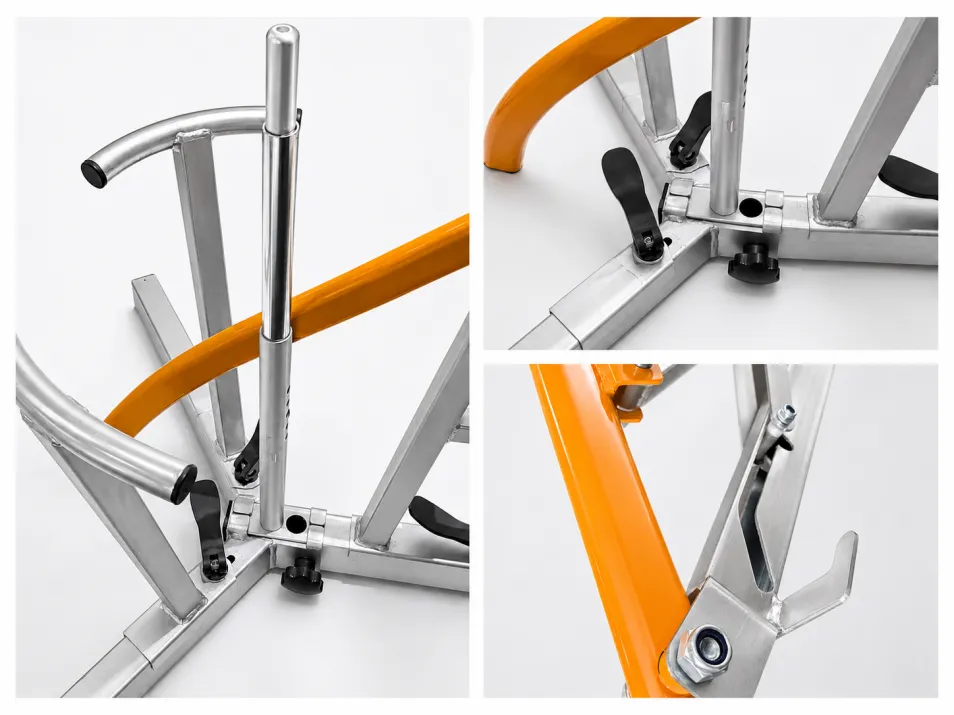
The Y-type model uses a lower, more open base arrangement with a long operating lever. The second model uses a larger upright-frame structure around the operating mechanism.
These differences show that a motorcycle tire changer stand does not need to follow one fixed frame layout.
The Y-type configuration keeps much of the lower working area open and compact, while the upright-frame version creates a more enclosed structural path around the mechanism.
Neither layout should be judged by appearance alone. The important question is how the base, frame, lever and tire-contact components work together when force is applied.
Steel Construction for Manual Tire-Service Equipment
Both motorcycle tire-service products shown in the EZLEE use steel construction with powder-coated surfaces.
Steel is well suited to this type of equipment because the structure can be manufactured through conventional processes such as tube cutting, plate forming, drilling and welding.
Actual performance, however, depends on more than the material name.
Tube dimensions, bracket geometry, weld locations and lever connections all influence rigidity and consistency.
Powder coating provides the exterior finish and helps protect the steel during normal workshop handling. Particular attention is needed around welds, corners, holes and tube ends, where poor surface preparation is more likely to become visible.
Manual Motorcycle Tire Changer vs. Powered Tire Changer
The two product types serve different workshop requirements.
| Feature | Manual Motorcycle Tire Changer Stand | Powered Tire Changer |
| Operation | Mechanical leverage | Powered operation |
| Structure | Relatively simple | More complex |
| Floor space | Compact | Larger |
| External power | Normally not required | Usually required |
| Operator involvement | Higher | Lower |
| Typical use | Manual or lower-volume tire service | Higher-volume tire service |
A manual stand is not intended to replace every function of a powered tire-changing machine. Its main advantages are compact dimensions, mechanical simplicity and controlled manual operation.
Production Consistency Matters Beyond the First Sample
A good sample proves that a design can work. It does not automatically prove that every unit in a production batch will perform identically.
For a motorcycle tire changer stand, relatively small dimensional variations can affect actual operation.
A bracket welded at the wrong angle can alter the tire-contact position. An uneven base can affect stability. Variation in the lever connection can create excessive movement or make operation unnecessarily tight.
For bulk production, important controls therefore include:
- welding fixtures,
- component positioning,
- dimensional inspection,
- and assembly verification.
These controls help ensure that the operating geometry of the approved sample is repeated during mass production.

Motorcycle Tire Changer Stand Manufacturing with EZLEE
EZLEE’s motorcycle workshop range includes the two manual motorcycle tire stripper structures above, together with wheel balancers and other motorcycle maintenance equipment.
For an OEM, ODM or private-label motorcycle tire changer stand, development can focus on the actual mechanical requirements of the product, including base dimensions, frame layout, lever length, lever connection, tire-contact geometry, intended tire range, steel specification and surface treatment.
Color, labeling and packaging can then be developed around the customer’s own product program.
For this type of manual workshop equipment, three fundamentals remain:
stable support, effective leverage and controlled tire contact.